

I took the bus from Cusco early in the morning to travel in some 9 hours via the Puna/Altiplano (the names of the 4000 meter high plateau, some beautiful mountains in the back) to the Lake of Titicaca, to Punto.
The Lake of Titicaca lies at an altitude of 3814 meters, and is roughly 15 times the size of the lake of Constance (Bodensee). To be more concrete, it is up to 194 km long, and the broadest part is 65 km. 60 % of the lake belongs to Peru, and 40 % to Bolivia or the other way around; the answer depends on which country you ask. Also, no one really knows who owns "Titi" and who "Caca". "Titi" means puna, and "kak" rock. When the sun god left earth and went up to heaven, he was believed to have left an imprint of his foot on the island of the sun. So, the first "isla de sol" was called Titicaca, and later the entire lake.
As interesting as the history and geography of lake may be, it is the people who inhabit the region and their unique culture that is of greatest interest.
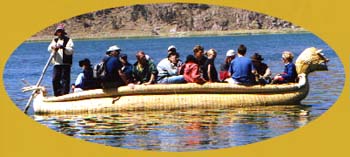
The swimming island of the Uros (Isla Flotantes)
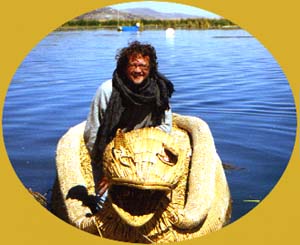
The Uros (an indian-tribe) lived on the Islas Flotantes for a long time. While the last pure "lakepeople" died in the 1950's, the Uros intermingled with the Aymara Indians, and now speak their language. The floating islands were built out of reeds and mud. The layers are approximately one meter thick and require restoration from time to timeas the water below rots away the lower layers. One must tread with caution on the islands or risk becoming the subject of a funny photograph for the rest of the tourists - one in which you appear to have no legs. The boats are built out of the same material, and only last for 6 to 12 months. (picture from me in the boat) . The island natives used to sustain themselves through hunting birds and fishing, but now the island economy is driven primarily through tourism.
Isla Taquile
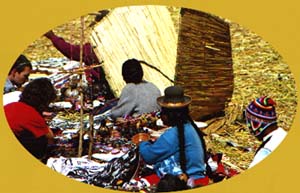
Another 2 ½ hours on the boat, and you arrive at the Isla Taquile. Isla Taquile is 6 km long and 1 ½ km across. The people on the island live a communal existence -- one for all, and all for one. So, when someone wants to build a house, the entire community helps and the new homeowner is expected to do the same for anyone else. The people of the Isla Taquile support themselves primarily through the production of textile products, espe-cially hats. They themselves wear clothes that signify both social and marital status. So, for example, one can see if someone is available by the way they carry their hat (Hey, that makes hunting easier).
There is another old ritual that got modern in the rest of the world
only in the last 20 years: At isla Taquile, a couple has to live together
for a couple of years, to see if they really want to get married; they
cannot get married immediately. If it doesn´t work, the search just goes
on.
I would highly recommend to everybody visiting lake of Titicaca, to spend
a couple of days on the island. It´s a very relaxed and nice atmosphere
there.