My climb of Cotopaxi & Chimborazo in
Ecuador


Getting a guided group together to climb Cotopaxi and Chimborazo turned out to be much more difficult than I anticipated. After 5 days of waiting to get a group together but at the same time healing my foot (remember I played soccer at the Galapagos), I finally decided to hire a guide just for myself and go ahead with acclimatization.
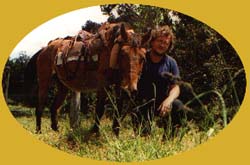
I took a day's rest (before heading over to Cotopaxi) and used it to ride up the mountain on horseback and relax at "La Estacion", a very nice hostel directly under Corazon.
The 1965 Land Rover took us as far as the parking lot at 4.600 meters. From there we walked up the last 200 meters to the hut. It was still early (02:30 p.m.) and so we went over to the glacier to exercise some crevasse rescue techniques.
We ate dinner at 5:00pm and went straight to bed. But, at 4800 m, I couldn't sleep very well. I felt that my acclimatization program wasn't very good: I always made day trips to higher altitudes; I hadn't tried sleeping at the 4000 meter level (For everybody who wants to climb Cotopaxi: There are no huts at 4000 meters, but I'm sure you can get the approval to use your tent somewhere up there). At 11:45 pm people started to put their gear together, so we did too. A hot tea, a couple of cookies, and at 1:00 a.m. we started to climb.
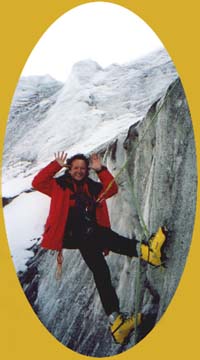
So, I started to count out 300 steps, and then we took a short break. Soon, I needed a break every 200 steps. By that time we had passed the wall of Yanasacha and from that time it went up with something like a 40 degree . By that point in the climb, I needed a break every 50 steps, then 20 steps and then, slowed by the altitude and knee-deep soft snow, 10 steps for the final 100m.
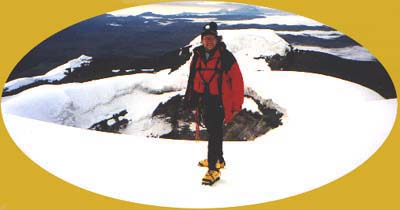
But suddenly, at 06:30 in the morning, there were no more steps to take, and we looked down into the crater. We had reached the summit in 5 ½ hours, a pretty good time. The normal range is 5 - 7 hours. That day, only 1 climber was faster than I, 2 followed closely and another 3 people came up 1 1/2 hours later. 8 people turned back before reaching the peak. We had been lucky -- the weather was perfect and visibility was over 100 km. The descent took nearly 2 hours, and I returned to the hut exhausted.
After only 1 day's rest, the guide and I packed up our gear for the drive to Chimborazo, the highest mountain in Ecuador at some 6300 meters. Chimborazo is actually comprised of 2 volcancoes. North of Chimborazo there is no higher mountain. And interestingly, due to the bulge around the equator, it is the farthest point from the center of the earth, and the closest place to the sun. It was first climbed by the British climber, Edward Whymper, and the Italian guides Jaen A. qnd Louis Carrel on January 4th, 1880.
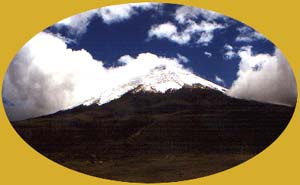
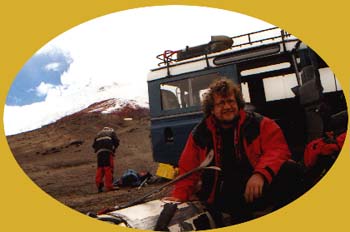
At 12:00 p.m. we reached the altitude of 5200 meters, the point were you normally put the crampons on. But at that point I decided that it was not my day to climb Chimborazo.