
" Che Guevara.
A Revolutionary Life"
Grove Press, New York
by Jon Lee Anderson
A Revolutionary Life"
Grove Press, New York
by Jon Lee Anderson

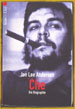
Ernesto Guevara de la Serna, known as "Che", died in October 1967 in Bolivia.
After his death, the army hid his corpse so that his gravesite would not become a place of pilgrimage. Traveling in Ecuador and Peru, one cannot escape the feeling that he is still alive: his picture adorns many walls, and while attending a concert at the University of Cuenca (organized by the communist party, which we hadn't known in advance) the local people interrupted the concert every 2 minutes, screaming:
"Che Guevara! Che Guevara!" Che was born on May 14th, 1928 in Argentina. Both of his parents were from wealthy families but were politically leftist. Che was originally trained as a medical doctor, completing his M.D. in 1953.
In his free time during his medical studies Che traveled extensively throughout Latin America. It was at that time he learned first hand of the rampant poverty throughout the region. Immediately after completing his medical studies, he traveled to Guatemala to support the President, Jacobo Arbenz Gunzman, who was attempting to implement his Socialist programs. However, within a year of Che's arrival, the Arbenz government and the the Socialist movement were derailed by the opposition party (and with U.S. intervention). At this time "Che" (he got this name because it is usual in Argentina to use a "Che" between sentences) developed a strong anti-U.S. sentiment and and began to devote his life to achieving a "worldwide revolution" for a world with greater socio-econimic fairness and equality.
After the change of the government in Guatemala, Che moved to Mexico, where he met the brothers Raul and Fidel Castro. The Castros were working to build enough rebel support to overthrow dictator Batista in their home country of Cuba. In late 1956, Che joined the brothers Castro and their small rebel army in their return to Cuba. Early on, they suffered heavy casualties against the Batista forces. But, as time went on, they were able to rebuild their forces to a much greater size and eventually took Havana on January 2nd, 1959. Che Guevara was given Cuban citizenship and was eventually appointed Minister for Industrial Development as well as President of the Central Bank of Cuba. In the years following the Cuban revolution, Che also wrote several books about guerilla warfare and the revolution itself.
In 1965 he left Cuba (possibly because he saw that Soviet-style socialism, which was partially introduced in Cuba, was not working and Che himself had established the Soviet ties) to pursue his ideal of a worldwide revolution. He spent 2 years in the Congo with little success, and than traveled incognito into Bolivia. In October 1967, a special unit of the Bolivian army found his unit and besieged him. They captured him alive, but executed him only hours later.
His corpse was finally found in 1997, largely due to the research of the author of the book. Jon Lee Anderson spent 5 years researching Che's life and eventual demise, uncovering many facts that had as yet been undiscovered. The book is a great piece on South American history.
I personally got the feeling that Che Guevara is such a popular hero in leftist circles, not because of his accomplishments, but rather because of his commitment to his ideals. Despite his privileged background and the positions of power he achieved in post-revolutionary Cuba, he spent the rest of his life working to bring about world revolution, a life which there were no special privileges for himself nor his family.